
 GAME PATCH NOTES
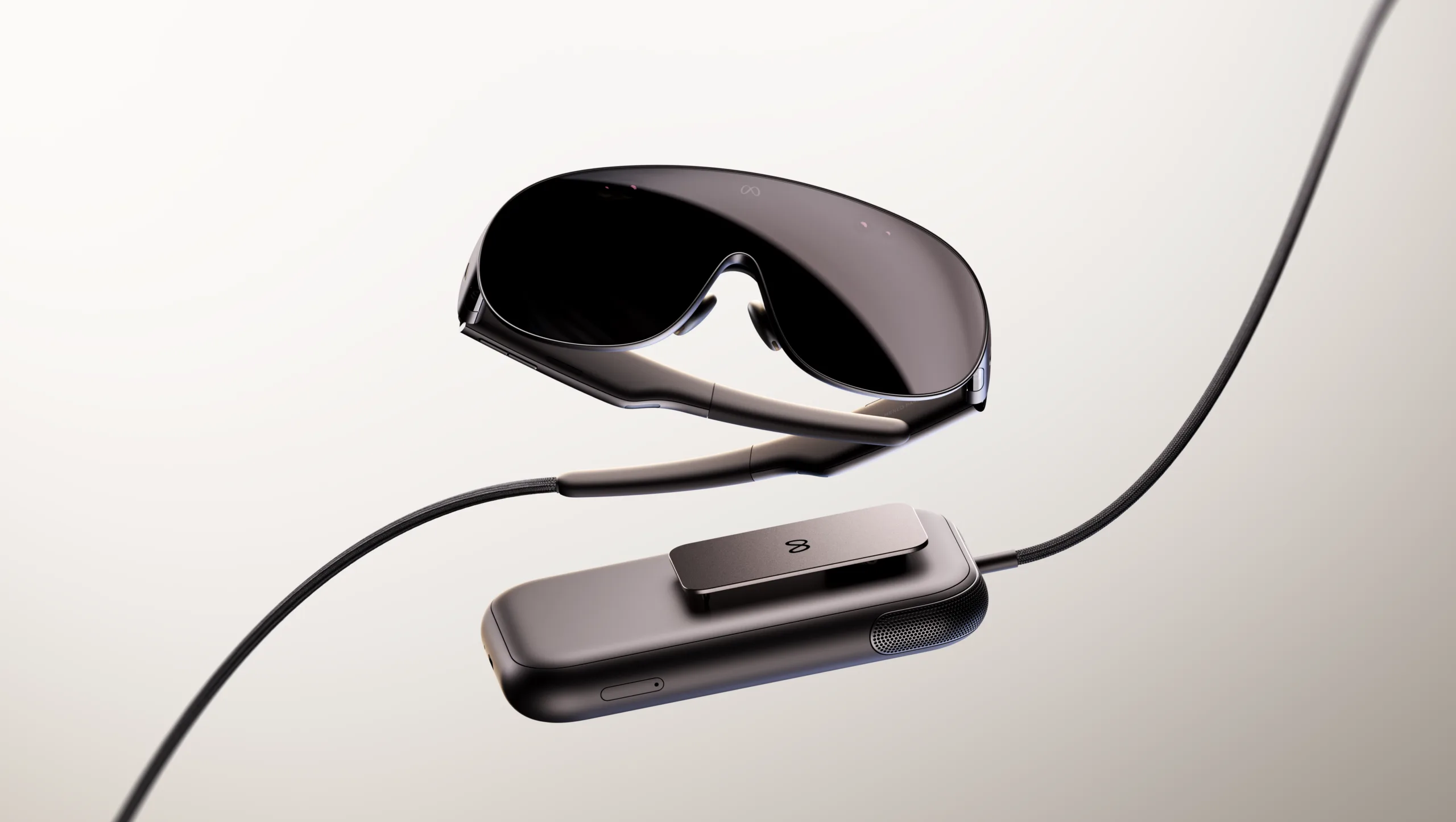
Meta's next VR headset is not a headset at all — it is a pair of glasses. Meta VR Glasses, announced at Meta Connect on September 23, 2026, go on sale in spring 2027 for $1,299.99 in the US, and they are Meta's most ambitious attempt yet to make virtual reality something you can wear all day: a personal cinema, a courtside seat, a multi-screen workspace and a gaming console, all in a device that weighs about 100 grams.
The weight is the whole idea. Meta VR Glasses are five times lighter than Meta Quest 3, and that is only possible because of a two-part system. The glasses themselves handle just the sensors and display, in a magnesium alloy frame that provides rigidity and strength while helping keep everything cool. Everything else — the compute, the battery and the storage — lives in a puck connected by an optical tether, which clips to a pocket or bag. There are no straps and no heavy hardware on your face, and the open sides and passthrough camera keep you aware of what is happening nearby, so you can watch a full movie or get work done on a long flight while still sensing the world around you.
The display is where Meta is making its biggest claim. The glasses use a 5K Infinite Display built on micro-OLED panels, with 37 pixels per degree for sharp text and detail, and ultra-compact pancake lenses built specifically for this device. That works out to 2,412 x 2,288 pixels per eye at up to 120Hz, with Dolby Vision, HDR10 and HLG support and Dolby Atmos spatial audio built directly into the frames. Meta calls the glasses its most advanced and lightest VR device yet, and the display is the reason: cinema-grade clarity in something that looks like glasses.
You do not need controllers to use them. Eye tracking and hand tracking are the primary inputs, with voice and Meta AI built directly into the operating system — look at something to highlight it, pinch to select, talk to the glasses to play a movie, open an app or adjust your workspace. Meta Quest Touch Plus controllers are supported for the full Quest catalog, but they are sold separately, and interactions designed around Quest controllers map to eyes and hands instead.
Entertainment is the pitch Meta leads with, and it has lined up partners to back it. Meta VR Glasses are the first IMAX Enhanced certified VR device ever, and one of the only ways to experience select films in IMAX's exclusive expanded aspect ratio at home. Disney+ subscribers can already stream movies like Marvel's The Avengers and Black Panther in 3D on Quest in select countries, and when the glasses launch in the spring, VR Enhanced versions of Avengers: Infinity War and Star Wars: A New Hope arrive in the new Disney Immersive Cinema app, with themed environments like Tatooine and Avengers Tower. Prime Video, YouTube, DIRECTV, AMC+, Crunchyroll, Plex and Tubi are on board through the TV app, and Peacock, HBO Max and Paramount+ are offering their 3D catalogs for the first time. Sports get the same treatment: ESPN's Immersive Sports brings a front-row seat with 8K streaming and 180-degree views, and Meta says there will be over 100 immersive live sports events a year from MLB, NBC Sports, TNT Sports and UFC.
Gaming is there too, but it is not the headline. More than 75 games will be playable at launch using hand gestures alone, and pairing Touch Plus controllers opens up the Meta Quest catalog with thousands of titles. Xbox Cloud Gaming streams hundreds of games straight to the glasses with a Bluetooth gamepad, and you can connect a handheld gaming device wirelessly or over USB-C to play on a big virtual screen. The glasses can even act as an external display: a DisplayPort input on the puck lets them serve as a Mac, Windows or console monitor.
Work is the other half of the pitch. The glasses give you a massive screen — or several — anywhere you are, turning any table or desk into a surface keyboard and touchpad so you can type without carrying extra hardware. You can connect a Mac or Windows PC wirelessly or over USB-C and pick up where you left off, bringing your own keyboard and mouse, while full-color passthrough keeps your desk, phone and surroundings visible. And for calls, Meta is introducing hologram technology: a photorealistic digital version of you, with real-time expressions and reactions, for hands-free video calling that works across WhatsApp, Zoom Workplace and other calling apps.
How do the glasses stack up against the Quest headsets you can buy today? Meta's own developer comparison lays it out:
| Spec | Meta VR Glasses | Meta Quest 3 | Meta Quest 3S |
|---|---|---|---|
| Form factor | Glasses with a compute puck | All-in-one headset | All-in-one headset |
| Display | micro-OLED, Dolby Vision / HDR10 / HLG | LCD | LCD |
| Resolution per eye | 2,412 x 2,288 (37 PPD) | 2,064 x 2,208 (25 PPD) | 1,832 x 1,920 (20 PPD) |
| Field of view | 70° horizontal, 66° vertical | 110° horizontal, 96° vertical | 96° horizontal, 90° vertical |
| Chipset | Snapdragon Reality Elite | Snapdragon XR2 Gen 2 | Snapdragon XR2 Gen 2 |
| Memory | 12 GB | 8 GB | 8 GB |
| Tracking | Head, hand and eye | Head and hand | Head and hand |
| Battery | Up to 3 hours of media playback | About 2 hours | About 2.5 hours |
| Wi-Fi / Bluetooth | Wi-Fi 7 / Bluetooth 5.4 | Wi-Fi 6E / Bluetooth 5.2 | Wi-Fi 6E / Bluetooth 5.2 |
The trade-off is clear in that table. The glasses win on sharpness, weight and media playback, but their 70-degree field of view is much narrower than the Quest 3's 110 degrees — this is a device built for watching, working and casual play, not for the wide, immersive worlds that made Quest a gaming headset. That positioning is deliberate: Meta is selling a cinema and a workspace first, and a console second.
There is still no exact launch date inside spring 2027, and preorders are not open — Meta's product page takes email sign-ups for launch news. The $1,299.99 price puts the glasses in a premium tier well above the Quest 3S, which Meta has just cut to $296.99 for Black Friday, so this is not a replacement for Quest. It is a second product line for people who want VR that fits in a bag and disappears on their face. With the holiday season now running on Quest deals and the glasses still months away, spring 2027 is the date to watch — and the wait is the price of the lightest VR Meta has ever built.