
 GAME PATCH NOTES
Anthropic has launched Claude Ship in beta, a set of AI agents that takes a pull request through review, fixes, and an approval decision, so teams can move code from draft to merge without babysitting each step. The announcement was published on November 23, 2026, and the tool is available now for teams on Claude Team and Enterprise plans with repositories on GitHub.
The idea behind Claude Ship is simple: developers increasingly write code with AI agents, but the steps after a pull request opens have stayed manual. A developer finishes a change, opens a pull request, and then waits while a reviewer reads it, asks for fixes, and eventually approves it. Anthropic says that on its own Claude Code team, Claude now writes most of the code, so the company wanted everything after the pull request to move just as fast. Claude Ship is its answer to that bottleneck.
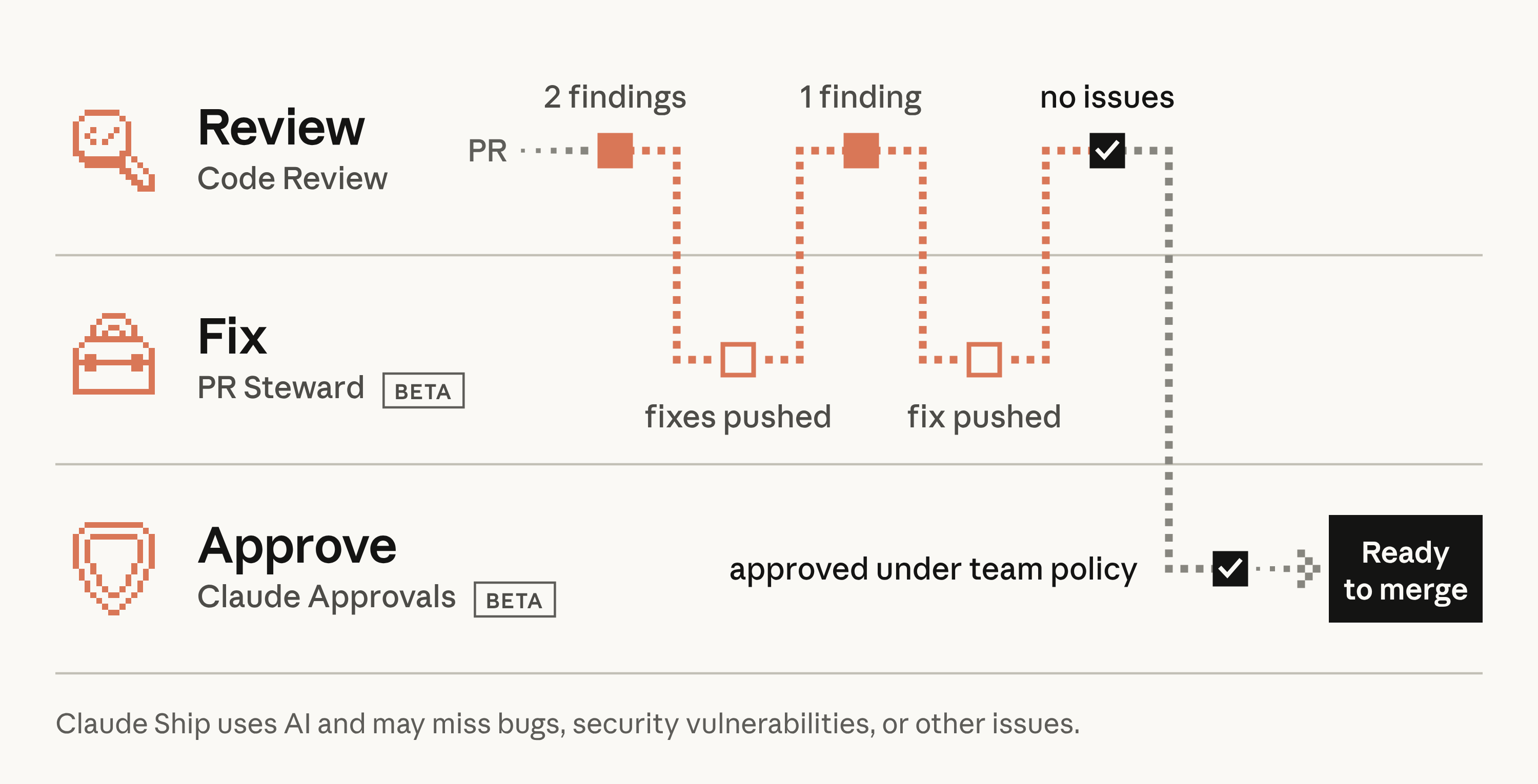
Claude Ship is made up of three parts. Code Review, which reviews pull requests, is already generally available. Two new agents join it in beta: PR Steward, which fixes pull requests, and Claude Approvals, which decides whether a change is ready to merge. Together they carry a pull request through review, fixes, and an approval decision, while teams stay in control of where the agents run and which changes still need a person.
| Component | Status | What it does |
|---|---|---|
| Code Review | Generally available | Reviews pull requests in depth and posts findings |
| PR Steward | Beta | Keeps a pull request green by fixing failing checks, conflicts, and review feedback |
| Claude Approvals | Beta | Approves changes that match a team-written policy, or sends them to a human |
Code Review performs an in-depth review of a pull request against the codebase, looking at it through multiple lenses. It collects findings, checks them against each other, sorts them by category, and posts them to the pull request. Teams can choose a review level for each repository: Quick, Standard, or Deep. Anthropic points to its own results as evidence the approach works. On the Claude Code team, where Claude's review is one layer of a broader process, the number of merged pull requests more than doubled from June to September, while the share of merged pull requests that had to be reverted fell by more than 40 percent.
PR Steward works to keep a pull request green, but it is deliberately designed not to approve or merge pull requests. It jumps in when continuous integration checks fail, when a merge conflict appears, or when review feedback arrives from Code Review, another review tool, or a team member. After every push, it comments with what it changed and how to undo it. Developers can steer it by commenting @claude with an instruction, or tell it to step back by commenting @claude stop.
Claude Approvals then applies an approval policy that the team writes as a file in the repository. Claude can approve routine changes on its own if the policy allows it, or it can require deeper human sign-off for certain scenarios. Anthropic describes it as working like a smarter CODEOWNERS file. The policy can weigh a variety of signals when making its decision, including Code Review findings or the team's own classifiers written in natural language. For most customers, Anthropic recommends enabling approvals first in observe-only mode, to build confidence before configuring branch protection to require Claude Approvals' green light.
Developers can also try Claude Ship on their own pull requests with a new /ship command in Claude Code. When a change is ready, they run /ship, and Claude pushes it, opens the pull request, reviews the change, and works on feedback and failing checks to help get it ready to merge. What can actually merge depends on the developer's permissions and the repository's branch rules. The /ship command is rolling out in Claude Code and the desktop app.
For admins and engineering leaders, Claude Ship can be switched on for an entire repository, putting it to work across a team's pull requests automatically, under settings and an approval policy the team controls. An admin turns on Code Review and PR Steward for each repository. Claude Approvals starts when a connected repository has a policy file on its default branch, and an admin can turn it off. Admins choose the review level, choose when reviews run, and configure spend limits. Claude Ship works with existing branch protection and required checks, and teams can start with a single repository, set a monthly spend limit, and run their approval policy in observe mode until they trust it.
Anthropic also describes how its own team uses the tool. The company runs Claude Ship on many of its own pull requests, and one of the biggest changes is who can act on customer feedback. A product manager on the Claude Code team can now read a piece of feedback, talk through ideas and tradeoffs with Claude, have it open a pull request, and move on to the next thing while Claude Ship takes it through review, fixes, and an approval decision. Anthropic gives a recent example: a customer was confused because the Analytics API documentation implied an Admin key could pull Pro and Team usage. The product manager asked whether a fix was in flight, Claude opened one, Code Review found nothing blocking, a docs reviewer signed off, Claude Approvals passed, and the fix merged that same evening.
There are limits on who can use it. Claude Ship is not available to organisations with Zero Data Retention, the HIPAA configuration, or customer-managed encryption keys. Usage is billed on tokens, so turning it on can add to an organisation's costs. The amount depends on the number and size of pull requests covered, the review level, how often reviews run, and how much work PR Steward does. Admins can set spend limits for Code Review and PR Steward. Claude Approvals has no base charge, but classifiers in a policy are billed on the tokens they use, and a policy that uses Claude's review triggers a billed Code Review, even in observe mode. Running /ship counts as regular Claude Code usage.
Eligible Claude Enterprise organisations can claim at least $10,000 in Claude Ship credits to use within 30 days of claiming, with claims open until January 15, 2027. Terms apply.
Anthropic is also clear about the tool's limits. Claude Ship may miss bugs, security vulnerabilities, or other issues, and branch protection and required checks still apply. The agents are a layer on top of a team's existing process, not a replacement for it. For teams that already use Code Review, the next step is adding PR Steward on a repository and an approval policy in observe mode. Teams new to Code Review can follow Anthropic's setup guide to connect GitHub and turn on their first repository. The bigger question for the industry is whether AI-approved merges become routine: if teams grow comfortable letting a policy file decide what ships, the pull request bottleneck could shrink dramatically, but only as far as teams trust the review behind it.