OFFICIAL Written by GPN · Nov 16, 2026, 1:52 AM ET · OpenAI · AI
OpenAI has published the first guest post on its new science blog, from physicist Nathaniel Craig, a visiting scientist at OpenAI who leads the particle theory group at the University of California, Santa Barbara and is a permanent member of its Kavli Institute for Theoretical Physics. In the post, Craig describes working with GPT-6 Astra on a candidate lattice definition of the Standard Model.
The Standard Model describes the known elementary particles and three of the four fundamental forces — the strong force, the weak force, and electromagnetism — and its predictions match experiment across eighteen orders of magnitude, from hydrogen's 21-centimeter radio emission to collisions at the Large Hadron Collider. Yet after more than fifty years, the theory still lacks a complete nonperturbative definition: an exact description that does not treat interactions as small corrections.
The idea Craig and Astra pursued puts the theory on a lattice, a grid standing in for spacetime. On a grid, the smallest distance that can be resolved is set by the spacing, and the theory can be defined rigorously at that spacing and calculated on a computer. The same approach has already produced a quantitative understanding of the proton's mass from first principles.
The hard part is that the weak force is chiral: it treats left-handed and right-handed particles differently, and it lacks reflection symmetry. Naive lattice rules create an unwanted right-handed partner for every left-handed particle, a problem known as doubling. Earlier work by Ginsparg and Wilson, Narayanan and Neuberger, Lüscher, and Kikukawa and colleagues built the tools to handle left- and right-handed fermions on a lattice, but one piece was still missing: getting the phase of the theory right. Lüscher had solved that step for simpler theories, but aligning it for the full Standard Model had stayed open for more than twenty-five years.
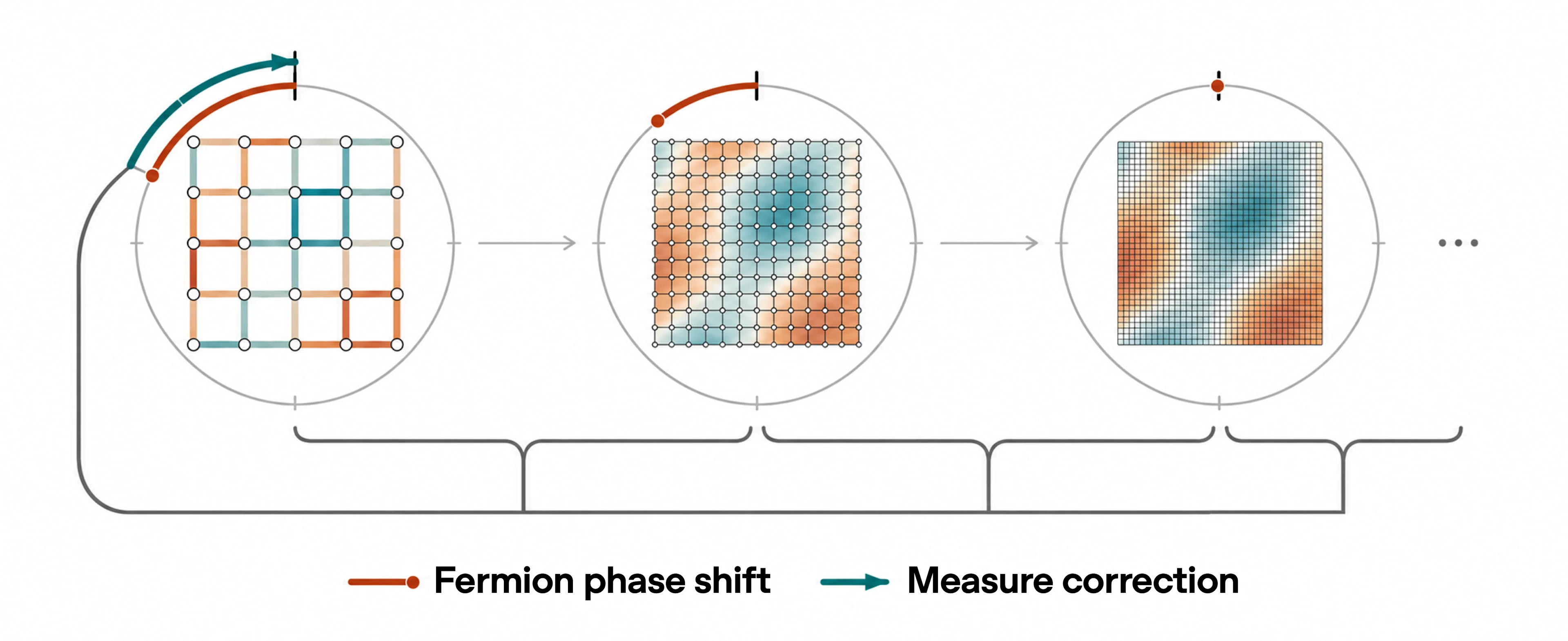
Craig's approach represents the force fields on a succession of finer and finer grids, compares the fermion states on each grid to the next, and adds up the corrections to get the phase rule on the original grid. The proof shows the construction gives the right correction around every allowed loop, that the correction at any one spot depends mainly on the fields nearby, and that different mathematical descriptions of the same fields give the same answer. Astra suggested the right way to carry the force fields onto the finer grids, showed the comparisons would converge to a definite answer, and took the lead in developing the detailed proof. Lattice field theorists Maarten Golterman, Andreas Kronfeld, and Yigal Shamir reviewed Astra's proof.
The result is a candidate definition of the Standard Model at finite lattice spacing, under a bound on field strengths at the scale of the grid. It is an answer in principle, not in practice: much work remains before it can be used for realistic lattice simulations, and questions remain about reflection positivity at finite spacing and about defining the interacting theory in continuous spacetime. OpenAI's recent proof of the existence of Yang-Mills theory provides a missing piece for that next step, allowing the simplest unified Yang-Mills theory — including the gauge fields and fermions of the Standard Model — to be shown to exist by starting with overlap fermions on a lattice and taking the continuum limit.
The work was set out in an October preprint prepared with the aid of GPT-6 Astra, and Craig's post is the first guest post on OpenAI's science blog.
 OpenAI Brings Computer-Use Agents and 20+ Plugins to ChatGPT for HealthcareOpenAI · AI
 OpenAI Opens a Science Blog to Show How Researchers Are Putting AI to WorkOpenAI · AI
 OpenAI Gives £1 Million to The King's Trust to Teach AI Skills to 25,000 Young PeopleOpenAI · AI
 ChatGPT Will Now Surface Les Echos and Le Parisien Stories Under New OpenAI–LVMH DealOpenAI · AI