NVIDIA has announced new collaborations with IBM and the U.S. Department of Energy's Fermi National Accelerator Laboratory, spanning research into next-generation modular quantum computer architectures, scientific applications and supercomputing integration.
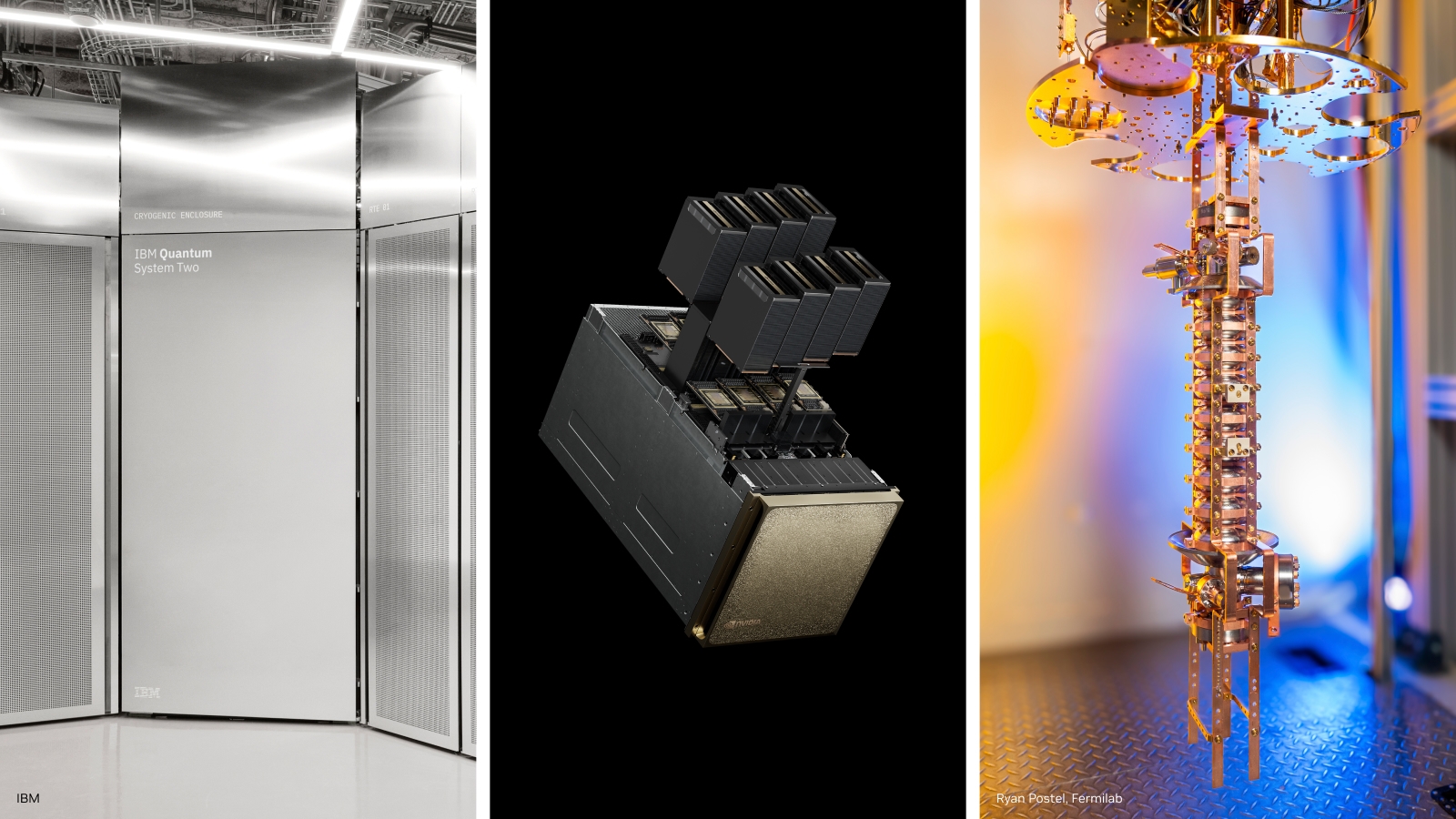
At the centre is a modular quantum computing codesign platform built by IBM, Fermilab and NVIDIA. NVIDIA DGX B200 systems are being colocated with IBM quantum computers, including those powered by IBM Quantum Nighthawk, the most powerful quantum processor IBM has built. The platform will let researchers develop and evaluate error-correction codes, decoding algorithms and quantum-classical applications, with Fermilab's work focused on quantum error correction and high-energy and nuclear physics.
Separately, NVIDIA released TCBP-JOBS, a new decoding algorithm in the CUDA-Q QEC 0.9.0 library that delivers up to 13,000 times faster decoding for quantum error-correction research — cutting the computation time for researching new quantum designs from 12 weeks to 45 minutes.
NVIDIA is also expanding the open-source Slurm workload manager with a quantum interface so quantum processors can be scheduled alongside CPUs and GPUs, with IBM contributing integration through its Quantum Resource Management Interface.
In related work, IBM and RIKEN are advancing quantum-classical chemistry research powered by NVIDIA accelerated computing, named a finalist for the 2026 ACM Gordon Bell Prize. The team modelled complexes of up to 12,635 atoms — more than 40 times the size of the previous 303-atom quantum-classical benchmark — using RIKEN's ROQUO supercomputer, which runs NVIDIA GB200 systems and Quantum-X800 InfiniBand networking.