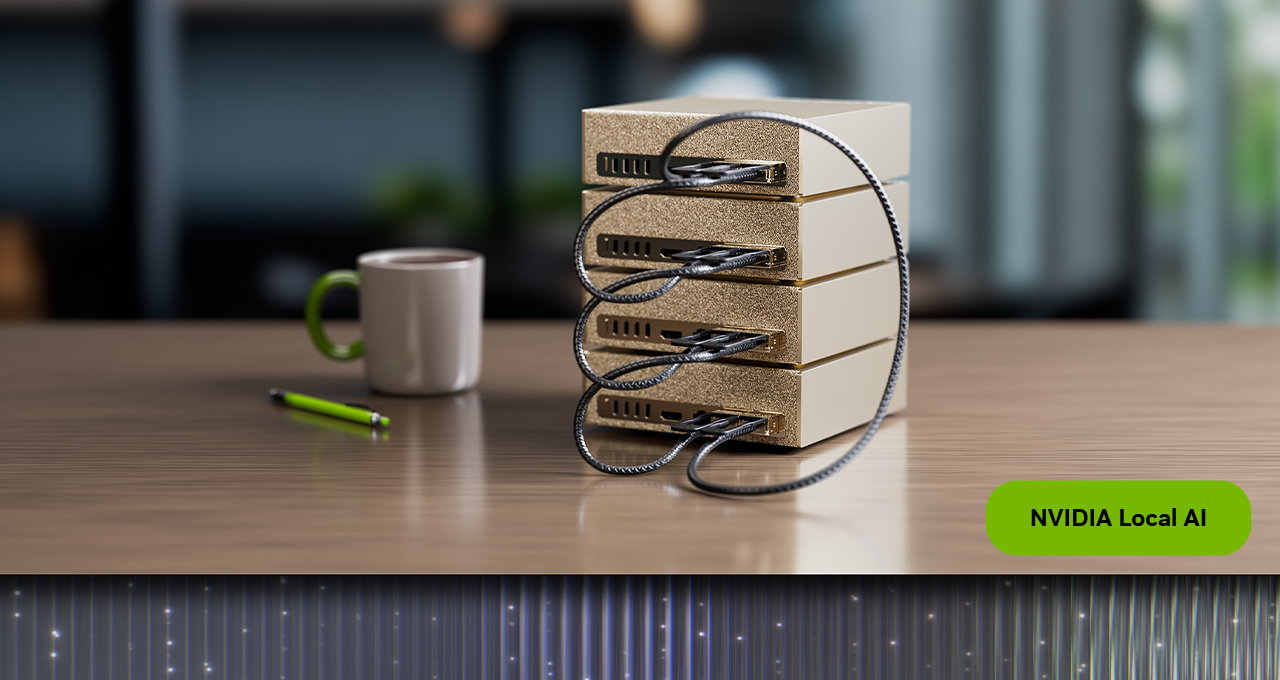
NVIDIA has introduced the DGX Spark HPC Developer Kit at SC26, the annual supercomputing conference taking place this week in Chicago, and it turns a desk into a small supercomputing lab. The kit is a four-node cluster of DGX Spark systems, each connected directly to its two neighbours in a ring over NVIDIA ConnectX-7 networking, with no network switch to buy or set up.
Each node carries the GB10 Grace Blackwell Superchip, and the cluster scales from one system to four. At full size it offers 512GB of combined memory and 20TB of NVMe storage, and with NVFP4 it can run models with up to 700 billion parameters locally across the four systems, such as DeepSeek V4.1. That means researchers with a fixed compute allocation no longer have to wait in a queue on a shared GPU cluster for every job: they can develop and debug at their own desk and save server hours for production runs, keeping unpublished results and proprietary data on premises. An NVIDIA HPC SDK playbook is coming soon, bringing GPU-accelerated C, C++ and Fortran compilers, libraries and message passing tools to the cluster, the same development tools used on NVIDIA-powered supercomputers.
The kit is built for real scientific work, not just demos. Demonstrated four-system workloads include LAMMPS with Kokkos for materials simulation and NAMD for molecular dynamics, while the wider DGX Spark community has validated GROMACS, OpenFOAM for fluid dynamics, WRF for weather modelling, and NVIDIA NIM microservices such as OpenFold3 and Boltz-2 for predicting biomolecular structures. Researchers are already using it in the field: Kvantify runs tensor-network simulations of quantum-chemistry circuits with up to 70 qubits and 975 gates on a single DGX Spark, CYRAN AI accelerates JPEG 2000 decoding for large satellite images, OpenFold is fine-tuning OpenFold3 for drug discovery, and a UC Berkeley lab predicting bacterial traits from genome sequences got results 15 times sooner with no 11-hour cluster queue. Another Berkeley group is LoRA fine-tuning a 120-billion-parameter chemistry model in eight- to 24-hour fits, back to back.
The developer kit is on display at SC26 and available for sale through top OEM partners, including Acer, ASUS, Dell Technologies, GIGABYTE, H3C, HP, Lenovo, MSI and xFusion, as well as through NVIDIA Marketplace.