
OpenAI has released a new tool to detect child sexual abuse material, interventions that interrupt harmful behaviour and point people toward help, practical resources for developers, and support for child-safety law enforcement investigators. The work builds on the company's Child Safety Blueprint.
The centrepiece is a new image classifier that can detect potential child sexual abuse material, including AI-generated material. It looks for visual signs of abuse, helping teams identify novel images that may not have been seen before, and returns scores that help reviewers decide which images need attention first. OpenAI says it is the first CSAM classifier with broad availability that has a specific signal for whether CSAM may be AI-generated.
The classifier was trained, evaluated, and designed for real-world deployment with help from the National Center for Missing and Exploited Children, which operates the CyberTipline. OpenAI is offering access to vetted organisations through its API at no cost, and has engaged the Tech Coalition and ROOST to help share access. It has also joined the Tech Coalition's Lantern program to share and receive signals about online child sexual exploitation.
Early tests suggest the classifier can help reviewers focus on abusive images while cutting review work. In an evaluation of user-uploaded images, OpenAI estimated the new classifier would flag 48% fewer images while finding roughly the same number of abusive images as its existing tool, and that images it flagged were about twice as likely to contain abuse. In partner testing, reviewers confirmed 72% of the classifier's high-confidence flags as novel CSAM, and in evaluations involving drawings or animations that sexualise children, it detected 90% of cases.
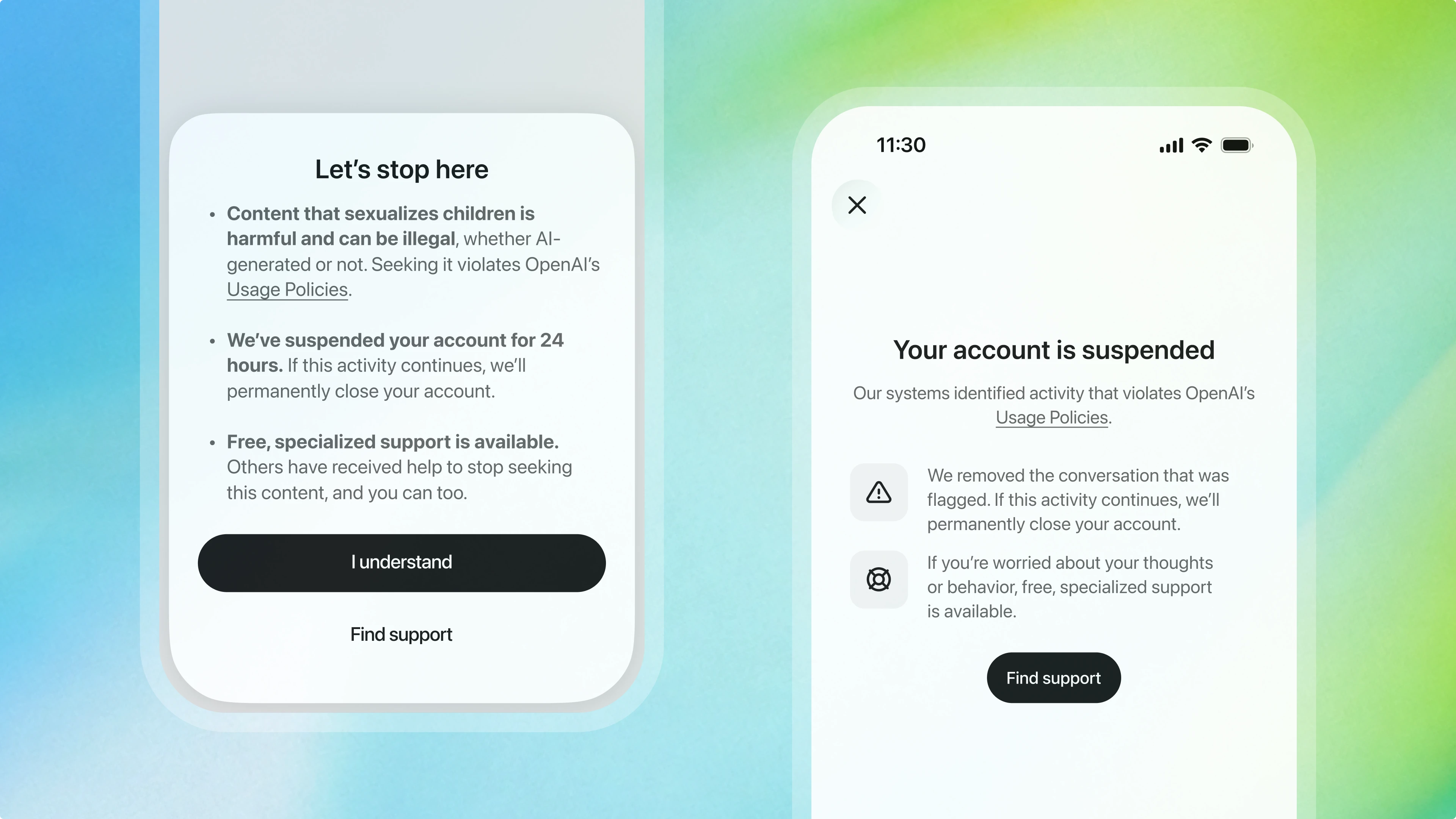
ChatGPT is also getting new product warnings that interrupt attempts to find abusive material, explain the consequences, and point people toward help. The flagged conversation is removed and access to ChatGPT is paused for 24 hours, while specialist support stays available. Repeated violations may lead to longer restrictions and ultimately account closure or reports to authorities. The approach was developed with Protect Children, the Lucy Faithfull Foundation, and academic advisors.
For developers, OpenAI has published CSAM guidance with input from the Tech Coalition, Thorn, the National Center for Missing and Exploited Children, and the Internet Watch Foundation. It has also worked with Anthropic and Google to jointly commission guidance on responding to disclosures of child sexual exploitation and abuse in AI systems. For investigators, OpenAI is providing new tools and training on using AI in investigations, including dedicated plugins and data analysis tools, with a first tool to help review lengthy chat logs and legal process returns, identify connections, and create timelines.